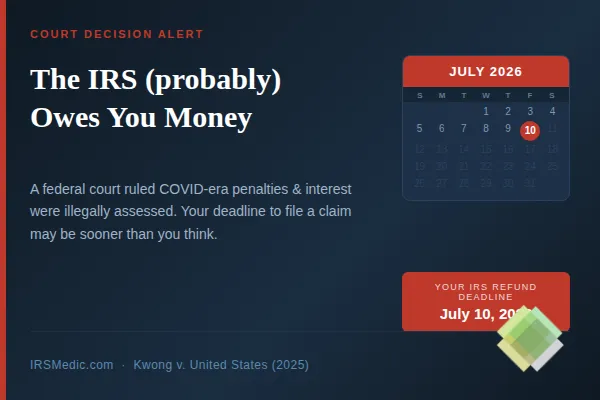
IRS COVID Penalties Refund: Kwong Ruling & July 2026 Deadline
The IRS (Probably) Owes You Money — But the Clock Is Running Out
A federal court just ruled that billions in COVID-era penalties and interest were illegally assessed. Here's what that probably means for you and the deadline you cannot miss.
By Anthony Parent, J.D. | IRSMedic.com
I want to tell you something the IRS is not going to send you a letter about.
A federal court has ruled that the IRS lacked the legal authority to charge millions of Americans failure-to-file penalties, failure-to-pay penalties, and underpayment interest during the COVID pandemic period. If you paid those charges — and a lot of people did — you may be entitled to get that money back.
The case is called Kwong v. United States, 179 Fed. Cl. 382 (2025). It was decided by the U.S. Court of Federal Claims on November 25, 2025. The mainstream tax industry has been slow to talk about it. The IRS has said nothing. And for most taxpayers, the deadline to file a protective claim is July 10, 2026.
That is 107 days from today.
I'm going to explain exactly what happened, who this affects, what you need to do, and — most importantly — why the IRS is never going to call you to let you know.
What the Court Actually Decided
During COVID, Congress passed a law — specifically the 2019 version of IRC Section 7508A(d) — that said federal tax deadlines are automatically suspended during a federally declared disaster. The suspension runs from the earliest incident date of the disaster to 60 days after the latest incident date.
For COVID-19, that math works out like this:
Earliest incident date: January 20, 2020
Latest incident date: May 11, 2023 (when the federal public health emergency ended)
Plus 60 days: July 10, 2023
That means, under the plain text of the statute Congress passed, every federal tax deadline that fell between January 20, 2020 and July 10, 2023 was automatically postponed to July 11, 2023.
The IRS didn't see it that way. The IRS treated COVID relief as a matter of administrative grace — meaning they gave out deadline extensions when they felt like it, for the amounts they chose, through guidance notices. They kept charging penalties and interest in many situations. They had a regulation — Treasury Regulation §301.7508A-1(g)(3)(ii) — that said the mandatory postponement could never push the total period beyond one year.
The Court of Federal Claims looked at that regulation and said: that's not what the statute says. The statute is unambiguous. Congress used mandatory language. The postponement is automatic, and it covers the entire disaster period plus 60 days, regardless of what the IRS decided to do administratively.
Then the court cited Loper Bright Enterprises v. Raimondo, 603 U.S. 369 (2024) — the Supreme Court decision that ended Chevron deference — and said: we are not required to defer to the IRS's interpretation of this statute. We read it ourselves. The IRS's regulation "misread" the statute.
The IRS lost. The regulation was wrong. The penalties and interest charged during that window were not legally authorized.
What This Means for You in Plain English
If you had any of the following during the period from January 20, 2020 through July 10, 2023, you may have a refund claim:
IRC §6651(a)(1) — failure-to-file penalties. Did you file a tax return late during this period and get hit with a penalty? That penalty may not have been legally assessable.
IRC §6651(a)(2) — failure-to-pay penalties. Did you pay your taxes late during this period and get charged a penalty? Same analysis.
IRC §6601 — underpayment interest. Did you have a tax balance that accrued interest during this window? The interest that accrued on deadlines that were postponed may be refundable.
Estimated tax penalties under §§6654 and 6655. Potentially covered as well.
Information return penalties on forms like 5471, 5472, and 8938 whose due dates track the income tax deadline. Also potentially in play.
This is not a small universe of people. Millions of Americans had tax problems during COVID. Many of them paid penalties and interest just to make the problem go away, often without knowing they had any choice. Some of those payments may now be refundable.
The Part Nobody Is Telling You: Your Deadline Is Personal
Here is where most articles about this case go wrong. They say "file by July 10, 2026" and leave it at that.
That date is the outer limit. But your actual deadline may be earlier — and it depends on the specific facts of your situation.
Under IRC §6511, the statute of limitations for a refund claim generally runs the later of:
Three years from the date you filed the return
Two years from the date you paid the tax
This means your personal deadline is calculated from your filing date and your payment date — not from some universal cutoff. If you filed your 2020 return in October 2021 and paid the balance at that time, your three-year window may expire before July 10, 2026.
This is exactly the kind of thing the IRS counts on you not knowing.
To calculate your actual deadline, you need your IRS account transcripts — specifically your account transcript, which shows the dates of every assessment and payment. If you don't know how to read those transcripts, that's what we do at IRSMedic.
Why the IRS Is Not Going to Tell You About This
I want to be direct about something, because I've been doing this for over 20 years and I've watched this pattern play out too many times.
The IRS does not send you letters that say "you overpaid, here is your money back." That is not how the institution operates. The IRS is not your partner. It is not neutral. It is a collection agency for the federal government, and its incentives do not run in your direction.
The Kwong decision is pending further proceedings — the parties were ordered to report on settlement discussions and proposed trial dates in December 2025. The IRS may appeal. That uncertainty is real, and I will not pretend otherwise.
But here is the clinical reality: uncertainty is not a reason to do nothing. Uncertainty is a reason to file a protective claim now.
A protective claim is exactly what it sounds like. You file Form 843 before your personal deadline expires, claiming the refund you believe you are owed under Kwong. You are not betting that you will win. You are preserving your right to collect if the law ultimately comes out in your favor. If the IRS appeals Kwong and wins, you lose nothing — you made a claim and it was denied. If Kwong is upheld or the government settles, your claim is on file and you get paid.
If you do nothing and your deadline passes, you have no claim regardless of how the law develops.
There is also a second legal basis for some of these claims that does not depend on Kwong at all. On December 26, 2025, Congress signed the Disaster Related Extension of Deadlines Act (P.L. 119-64) into law. This statute independently requires the IRS to treat disaster-period postponements as extensions of return deadlines for refund lookback purposes. Kwong and P.L. 119-64 are two separate arguments. A properly filed Form 843 can plead both.
A Word About the Larger Picture
This case is not just about money, though the money matters — for some people it matters enormously.
Kwong is a direct product of Loper Bright. The Supreme Court, in Loper Bright, took away the IRS's ability to hide behind regulatory deference. Courts are now required to read statutes themselves, independently, without giving the IRS the benefit of the doubt when its regulations diverge from what Congress wrote.
The tax industry hasn't fully absorbed what that means. Most practitioners are still operating as if IRS guidance is law. It isn't. The IRS's interpretation of a statute is now just an opinion — and courts can disagree with it, as the Court of Federal Claims did here.
This is the world I have been arguing for throughout my career. Read the statute. Ask what Congress actually said. Don't accept the IRS's framing as authoritative. Kwong is the Loper Bright doctrine in action, applied to a real penalty that real people paid, producing a real refund that real people can claim.
The tax industry invented compliance requirements that Congress never mandated. The IRS imposed them anyway. A court finally said no.
What to Do Right Now
Step 1: Get your IRS transcripts.
You can download them yourself from IRS.gov under "Get My Tax Record." Pull your account transcripts for tax years 2019 through 2023. These will show every penalty and interest assessment with the dates they were charged.
Step 2: Identify what you paid during the window.
Look for Transaction Code 276 (failure-to-pay penalty), Transaction Code 166 (estimated tax penalty), Transaction Code 196 (interest charges), and Transaction Code 170 (failure-to-file penalty) with dates falling between January 20, 2020 and July 10, 2023.
Step 3: Calculate your personal deadline.
This requires knowing when you filed and when you paid for each relevant tax year. If you are not sure, this is the most important reason to get professional help — a missed deadline is permanently missed.
Step 4: File Form 843 before your deadline.
Form 843 is the Claim for Refund and Request for Abatement. The supporting statement needs to cite the correct legal basis — Kwong v. United States, IRC §7508A(d) as in effect during 2019, and P.L. 119-64 — with the specific penalty and interest amounts you are claiming, calculated to the penny. Precision matters here. A vague claim is easy for the IRS to deny on procedural grounds.
How IRSMedic Can Help
We offer two paths.
If you want us to handle this completely — pull the transcripts, calculate the exact claim amount, prepare the Form 843 with a complete legal supporting statement, and manage the process — that is our DFY (done for you) service. Our Total Tax Diagnosis starts at $1,800 for individuals and includes a full transcript analysis, Kwong claim calculation, and complete filing package prepared and reviewed by a licensed tax attorney.
If you want to handle this yourself but want the analysis and documents generated for you — we have a DIY path through IRSMedicMembers.com where you upload your transcripts, the system calculates your claim, and you receive a complete attorney-quality Form 843 package to file yourself.
Either way, the most important thing is that you act before your personal deadline.
The Bottom Line
A federal court ruled that the IRS charged penalties and interest it was not legally authorized to charge during COVID. Congress passed a new law that reinforces the claim. The deadline to act is approaching — and for some people it is sooner than July 10, 2026.
The IRS is not going to send you a letter about this.
We are telling you because that is what we do.
Anthony Parent, J.D. is a tax attorney and founder of IRSMedic.com. He has represented over 3,000 clients in IRS disputes including offshore voluntary disclosures, criminal tax defense, penalty abatement, and complex resolution cases. He is the author of IRS Confidential: The Largest Heist in American History…Exposed.
Ready to find out if you have a Kwong claim?
Join the DIY waitlist at IRSMedicMembers.com You will be the first to be granted access.
For a Done-for-You solution book a time to speak with us at IRSMedic.com
Disclaimer: This article is for educational purposes and does not constitute legal advice. The Kwong decision involves ongoing litigation and the IRS may appeal. Filing a protective claim preserves your rights but does not guarantee a refund. Consult a qualified tax attorney to evaluate your specific situation.


